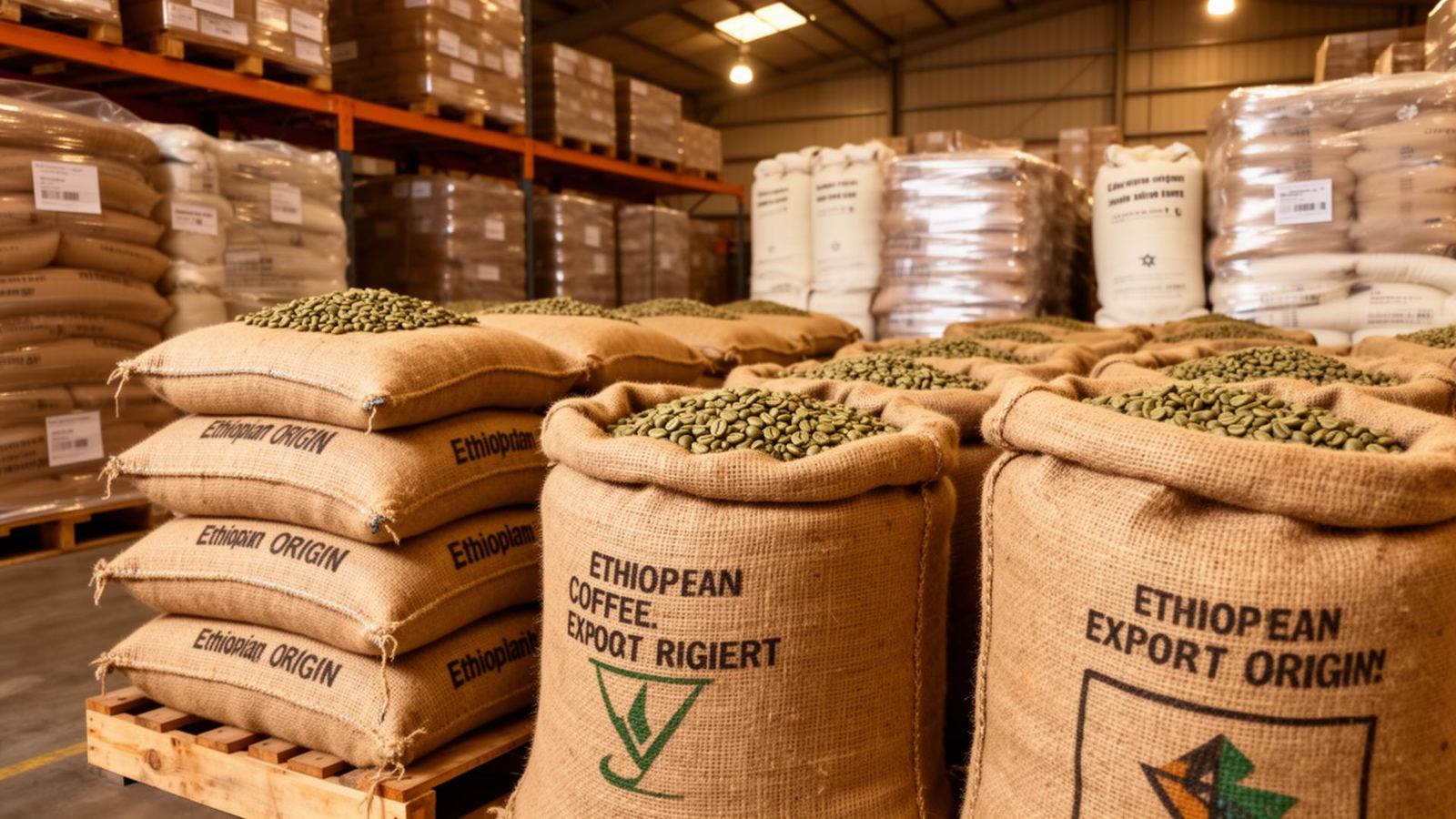
Green Ethiopian coffee imported into the UK is commodity code 0901 11 00. On the UK Trade Tariff (checked 16 October 2026) it carries 0% third-country duty and a 0% Developing Countries Trading Scheme rate for Ethiopia, so the practical work is proving origin (Form A or an origin declaration), holding the right customs registrations (EORI), and handling import VAT. Always re-check the tariff before you order, as rates and rules change.
Our Trade & Export Logistics guide covers shipping, storage and documentation for any destination. This page covers what is specific to importing into Great Britain, drawing only on UK government sources listed at the end. It is general information, not customs or tax advice; your customs agent or HMRC can confirm how the rules apply to your shipment. If you are buying for the EU as well, see the EU import guide.
What Does Importing Ethiopian Coffee to the UK Involve?
A Great Britain-bound green coffee shipment involves a customs declaration (classification, origin and preference claim), import VAT, and a check on whether any product-specific controls apply. For Ethiopian coffee the main points are the commodity code, the DCTS preference claim, and import VAT. Northern Ireland has separate arrangements that this page does not cover.
How Is Green Coffee Classified and Taxed in the UK?
Unroasted, non-decaffeinated coffee is commodity code 0901 11 00 on the UK Global Tariff (UK Trade Tariff). When we checked the Trade Tariff data on 16 October 2026, that code showed a 0% third-country duty. That means duty is nil whether or not a preference is claimed, though the preference claim below is still worth documenting in case rates change.
The same listing showed an import-control measure for organic products. It matters only if the coffee will be marketed as organic; conventional green coffee is not affected by it. Check the live tariff for your exact product and date, since measures are updated regularly.
How Does the Developing Countries Trading Scheme Apply?
The UK's Developing Countries Trading Scheme (DCTS) replaced the previous UK Generalised Scheme of Preferences. GOV.UK's business guide for Ethiopia states that Ethiopia benefits from the DCTS, and the Trade Tariff showed a 0% DCTS comprehensive-preference rate for code 0901 11 00 when checked on 16 October 2026.
To claim the preference, GOV.UK guidance on using the DCTS to import goods says you provide either:
- a Form A (it does not need to be stamped or signed by an authority in the beneficiary country, and a copy is acceptable), or
- an origin declaration on an invoice, packing list or consignment note that includes information identifying the originating product.
Both are valid for 2 years from their date of issue. On the customs declaration, the same guidance says to enter code 9001 (origin declaration) or N865 (Form A) in the documents field, and a code from the 200 series of preference codes in the preference field. Your customs agent will normally complete these fields; the practical point for buyers is to ask the exporter for the proof of origin ahead of shipment. See our Trade & Export Logistics guide for the Certificate of Origin and other export documents we prepare.
How Is Import VAT Handled?
The Trade Tariff listed the VAT rate for code 0901 11 00 as 0% when checked on 16 October 2026. Whatever rate applies, VAT-registered importers can usually avoid paying it at the border. Under postponed VAT accounting, import VAT is declared and reclaimed on the same VAT Return. GOV.UK says your business must be registered for VAT in the UK, the goods must be for use in your business, and your VAT registration number must appear on the import declaration. Businesses without a UK establishment must have their customs agent select this option and enter their details as consignee.
Do I Need an EORI Number?
GOV.UK says you may need an EORI number if you move goods between Great Britain and another country, and that you need it to make customs declarations or use customs systems. It adds that a business usually needs premises in the country it imports to. If you cannot apply yourself, you appoint someone to deal with customs for you, and that person gets the EORI number instead. Confirm your own position with HMRC or your customs agent before the first shipment.
Are There Plant-Health or Deforestation Rules?
Plant health. GOV.UK's guidance on importing plants and plant products from non-EU countries sorts goods into high-risk, medium-risk A, medium-risk B and low-risk categories; phytosanitary certificates are listed for the first three, and low-risk goods are exempt from plant health controls. The guidance does not name coffee, and the Trade Tariff listing we checked for code 0901 11 00 showed no plant-health import control for Ethiopia. Because categorisations can change, ask your customs agent to check the current category on the Defra Plant Health Portal for your shipment. Note that EU-bound coffee is handled differently (see our EU guide).
Deforestation. Schedule 17 to the Environment Act 2021 sets up due diligence duties for "forest risk commodities", but defines these as commodities specified in regulations made by the Secretary of State. Coffee is not named in the Schedule, and we have not found regulations in force that specify it. This is not an equivalent of the EU Deforestation Regulation, which does cover coffee. Check legislation.gov.uk and Defra for any change before you contract.
What Documents Does a UK Import Need?
In addition to the general export documents in our Trade & Export Logistics guide (commercial invoice, packing list, bill of lading, Certificate of Origin), a UK-bound shipment benefits from:
- DCTS proof of origin: a Form A or an origin declaration on the commercial documents
- Your EORI number (or your agent's) and, for postponed VAT accounting, your UK VAT number
- Any plant-health document your agent confirms is needed for the category in force at the time
Ready to source? Our wholesale inquiry form is the place to start; mention that you are importing to the UK so we can plan the proof of origin with you.
Sources and Scope of This Page
Jurisdiction: Great Britain (England, Scotland and Wales). Reviewed: 16 October 2026. Rates and rules were checked against these official sources on that date:
- UK Trade Tariff, commodity 0901 11 00 (duty, DCTS preference, VAT, import controls)
- GOV.UK: Use the Developing Countries Trading Scheme to import goods
- GOV.UK: Check when you can account for import VAT on your VAT Return
- GOV.UK: Get an EORI number
- GOV.UK: Import plants and plant products from non-EU countries to Great Britain
- Environment Act 2021, Schedule 17 (forest risk commodities)
This page is general information, not legal, customs or tax advice, and gives no guarantee about how a particular shipment will be treated.
Frequently Asked Questions
What commodity code applies to green Ethiopian coffee imported into the UK?
Do I pay import duty on Ethiopian green coffee in the UK?
What proof of origin is needed to claim DCTS preference?
Can I use postponed VAT accounting when importing coffee?
Does the UK have a deforestation law like the EU's EUDR for coffee?
GreenBean Coffee Editorial Team
Written by the export and quality control team at GreenBean Coffee, Addis Ababa. Our team has over 15 years of combined experience in Ethiopian specialty coffee sourcing, grading, and international trade logistics. All content is reviewed by licensed Q-graders and certified coffee professionals.
Last reviewed:
Ready to Source Premium Ethiopian Coffee?
Connect with our export team for samples, pricing, and availability. We ship Grade 1 & 2 Arabica to 40+ countries worldwide.